Fall Tree Inspections Before Seasonal Storms in Greensboro
Check dead limbs, cracked trunks, leaning trees, and root problems before fall storms arrive in Greensboro. A quick walk around your yard now can prevent major tree damage later.
Published
Part of our Tree Removal service.
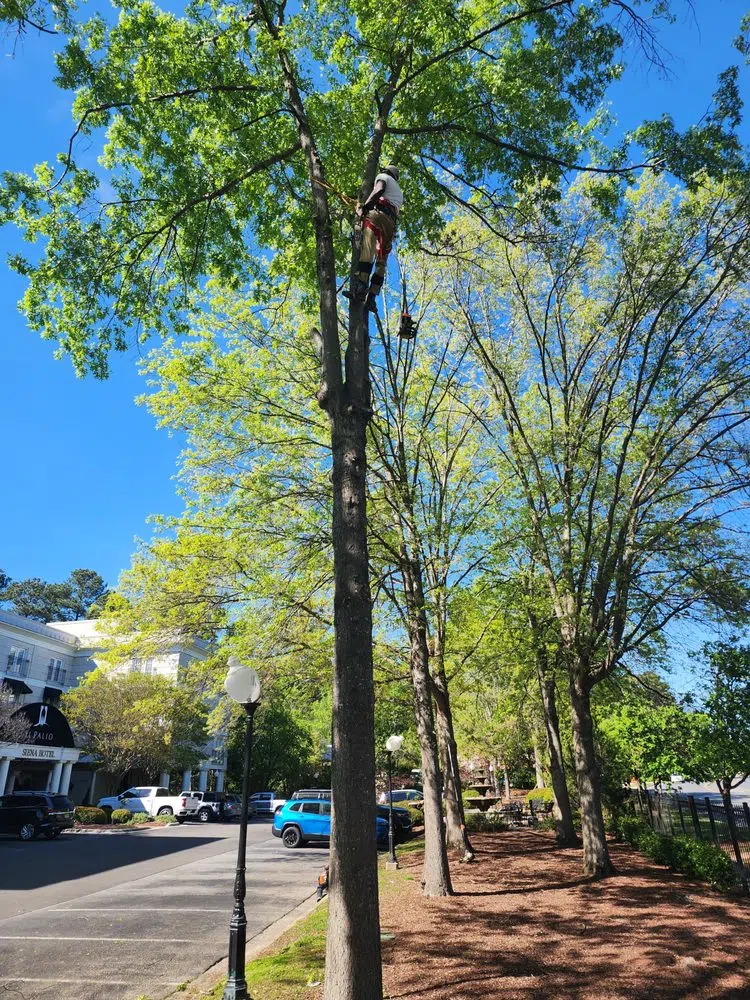
Dead limbs hanging in the upper canopy
Dead limbs are the most common storm failure on Greensboro properties. A branch that has stopped producing leaves in summer will not firm up when cold weather arrives. Wind catches dry wood differently than living wood, and a limb that looks fine on a calm October day can snap in the first heavy gust. Walk your property and look up. Dead branches usually appear gray or bare while surrounding growth is still leafed out. Some deadwood is normal on mature trees, but location matters. A dead limb over a driveway, roof, deck, or play area is a real risk, not just an eyesore. Crews address this through deadwooding, removing dead branches back to healthy wood or the branch collar so the tree closes the wound properly. If you spot several dead limbs on one tree, or dead sections concentrated on one side, note which tree it is and flag it for a professional look. You can handle a small dead twig with a handsaw, but anything above shoulder height or anywhere near a structure should wait for a crew with the right climbing and rigging equipment. Fall, before the storms arrive, is the ideal window to get it done.
Cracks or splits where branches meet the trunk
Branch unions take a beating through summer growth, and the damage often stays hidden until wind loads the tree. Before storm season, look closely at the spots where large limbs attach to the trunk. A visible crack, a split running down the trunk, or bark pulling away from a joint all mean the connection is weakening. Another warning sign is included bark, where bark grows between two stems instead of wood joining to wood. Trees with co-dominant stems, two trunks of similar size growing from the same point, are especially prone to this, and it is common in maples and Bradford pears around Greensboro. You can check for this yourself: if two stems form a tight V shape instead of a rounded U, look for a seam of bark pressed between them. That seam is a structural weak point that tends to fail in ice and wind events. Depending on what a crew finds, the fix may be pruning one of the stems, dynamic cabling to support the union, or removal if the split is already running. None of these are do-it-yourself jobs once the tree is large. Catching it during a fall inspection gives you options before the weather takes the decision out of your hands.
A tree that has started leaning or shifted
Trees can lean naturally and live that way for decades, so a lean by itself is not a reason to panic. The concern is change. If a tree that stood straight last year now tilts, or if the lean has visibly increased since spring, the root system may be giving way. Compare the trunk to a vertical line, and check whether the ground on the side opposite the lean is lifting, cracking, or bulging, which means roots are pulling loose. Also look for exposed or heaved soil around the root flare, the widened base where the trunk meets the ground. Covering that area with fresh mulch or dirt to hide it is a mistake; the problem stays and the evidence disappears. Sudden leans on Greensboro properties often follow wet summers that saturate the soil, and saturated soil plus fall wind is a bad combination. A leaning tree near a house, fence, or neighbor's property calls for a tree risk assessment before the first big storm, not after. The crew will evaluate whether the lean is stable, whether pruning can reduce the wind load in the canopy, or whether removal is the safer call. When removal is needed, doing it on a scheduled fall day is far better than an emergency call at night.
Fungal growth or soft spots at the base
Mushrooms and conks growing on or around a tree trunk look harmless, but they tell you wood inside the tree is decaying. Fungi feed on dead tissue, so visible growth at the base or on the trunk usually means internal rot you cannot see from the outside. Other signs to check during your fall walk: hollow-sounding wood when you tap the lower trunk, cavities or holes in the bark, bark sloughing off in patches, and soft spots where the wood gives under pressure. Decay at the base is more serious than decay high in the canopy because the base carries the whole tree. A tree with a sound canopy but a compromised root zone can fail at ground level with little warning, which is the scenario that damages homes and cars. Decay does not automatically mean removal. A crew will assess how much solid wood remains, whether the tree is a hazard in its current position, and whether the tree can be monitored or should come down. What you should not do is seal the fungus with paint or cut the mushrooms off and consider the problem solved. Document what you see, take a photo if you can, and get it evaluated before winter weather tests the tree.
Roots damaged, lifted, or cut in the last year
A tree is only as stable as its root system, and root damage from nearby work often goes unnoticed until the tree starts to struggle or lean. Think back over the past year. Was a trench dug for drainage, a fence, or utilities near the tree? Did new construction, a driveway extension, or heavy equipment pass over the root zone? Roots extend well beyond the drip line, the outer edge of the canopy, so damage can happen several feet from the trunk. Lifted sidewalks and driveways count too, because roots that buckle hardscape are often the same roots anchoring the tree. Check whether the soil around the base has settled or cracked, and look for roots that appear severed or crushed. A tree with significant root loss has less anchorage when fall and winter winds push against the canopy, and that is when failure happens. Not every damaged tree needs removal. Some recover with monitoring, and some benefit from crown reduction, thinning the canopy so wind has less to grab. But root damage plus a target, meaning anything the tree could hit, is a combination worth a professional opinion before storm season. Your Way Lawn and Tree can assess whether the roots can support the tree through another year.
Overcrowded limbs and excess canopy weight
A thick, dense canopy is a liability in a storm, not a sign of health. Wind moves through a thinned canopy and slows down; wind hits a dense one like a sail. Before the season turns, look at whether your trees have crossing branches, limbs rubbing each other, clusters of shoots growing straight up from the trunk, or so much interior growth you cannot see through the crown. These conditions catch wind and snow and transfer the load to weak branch unions. Crown thinning removes selected branches throughout the canopy to open airflow, and crown reduction shortens overly long limbs back to healthy lateral branches so they do not act as long levers in a gust. Done to ANSI A300 pruning standards, this work keeps the tree looking natural while cutting storm failure risk significantly. The timing matters too. Late fall is a good window in Greensboro because leaves are down, the structure is easy to read, and the tree is heading into dormancy. If your trees have not been pruned in several years and are large enough to reach a structure, schedule an inspection now. Preventive pruning is one of the cheapest forms of storm protection a homeowner can buy.
Trees leaning over your roof, driveway, or power lines
The final check is simple: walk your yard and ask, if this tree failed right now, what would it hit? Every tree has a fall radius roughly equal to its height, and anything inside that circle is a target. Pay particular attention to trees whose trunks lean toward the house, whose canopies hang over the roofline, or whose limbs reach near power lines. A tree over the driveway or a frequently parked car counts too. This check does not mean every nearby tree must come down. Many trees near homes are fine with periodic trimming and a healthy root system. But when a high-risk tree sits over a target, the inspection question shifts from whether it looks healthy to whether it can survive the worst storm of the season. That judgment needs a professional eye, because tree condition at the top and the base can differ sharply. If removal is the answer, fall is the practical time to schedule it. The ground is firm, the calendar is open before winter emergencies start, and the work is done on your timeline rather than at two in the morning during a storm. Your Way Lawn and Tree handles removals, cleanup, and stump grinding across Greensboro and nearby communities, and we are glad to walk the yard with you.
Ready to move forward? See our Tree Removal service
Related guides
Written by the Your Way Lawn and Tree team.
Fall Tree Inspections Before Seasonal Storms in Greensboro FAQs
When should I have my trees inspected in Greensboro?
Early fall is the best window. Leaves are dropping, so the branch structure is easy to see, and any problems can be fixed before winter winds and ice arrive. A walk around your property each September or October catches most issues while there is still time to schedule work calmly.
What are the warning signs a tree might fall in a storm?
Watch for a new or worsening lean, cracked soil or lifted ground around the base, large cracks where branches meet the trunk, mushrooms on the bark, hollow or soft wood, and recent root damage from digging or construction. Any of these near a house, car, or power line deserves a professional assessment.
Can I remove a dangerous limb myself instead of hiring a crew?
Small dead branches within reach with a pole saw are reasonable to handle yourself. Anything above shoulder height, anywhere near a roof or power line, or any large limb should be left to a crew with climbing and rigging equipment. Tree work sends more people to the hospital than most home projects.
Does a healthy-looking tree still need an inspection?
Often, yes. Internal decay, included bark between co-dominant stems, and root damage are invisible from the ground. A tree can look full and green while its base is compromised. If the tree stands over a structure or a parking area, a periodic check is inexpensive compared to storm damage.
Still have a question about your property? Talk to us